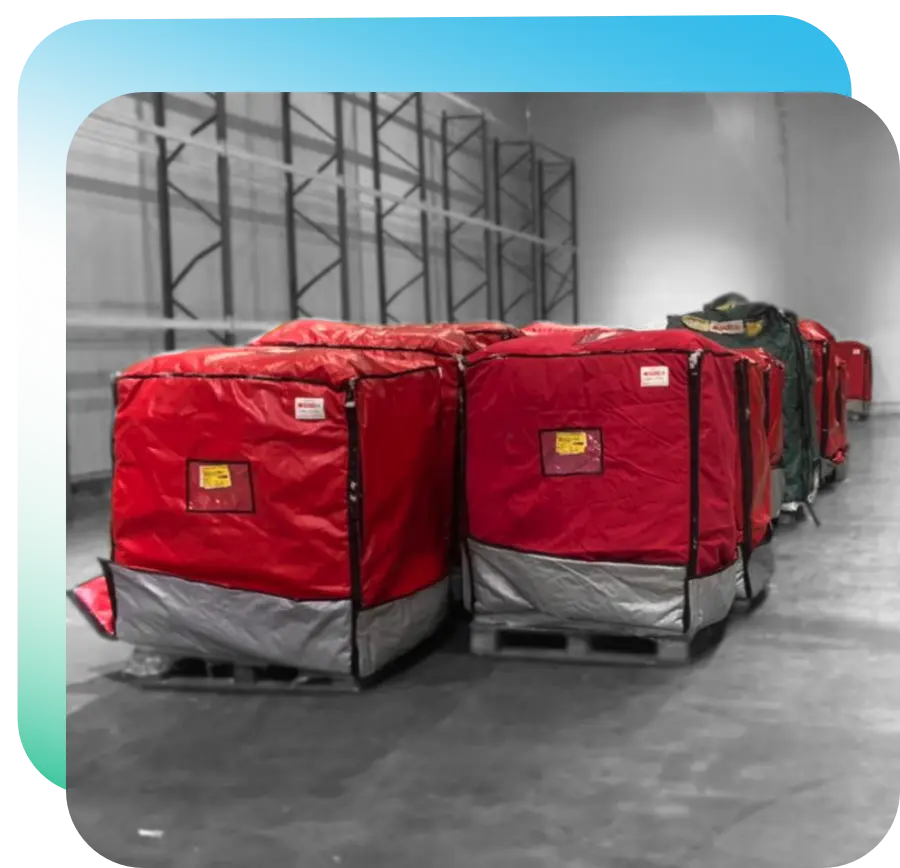
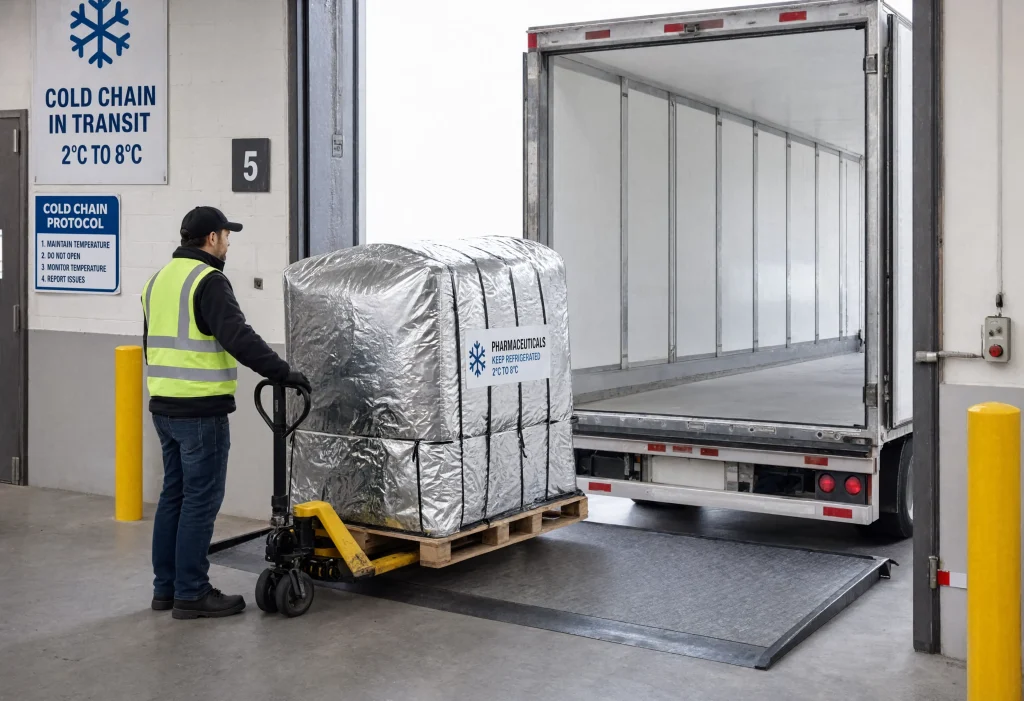
The most vulnerable window in pharmaceutical cold chain logistics is not the transit itself — it is the loading and unloading dwell time. Products sitting on a dock, moving between a refrigerated vehicle and a temperature-controlled warehouse, or waiting at an airport handling facility are exposed to ambient temperatures with no active cooling. A passive thermal cover is the most practical and cost-effective way to protect product integrity during these windows, and for many pharmaceutical operations it is the difference between a compliant shipment and a written-off consignment.
Why dwell time is the highest excursion risk in pharmaceutical cold chain thermal covers logistics
Active refrigeration protects product while it is inside a controlled environment. The moment product leaves that environment — even for a few minutes — active cooling is no longer working. On a 32°C Johannesburg summer day, a pallet of temperature-sensitive medicines sitting on an open loading dock for 20 minutes can experience significant temperature drift, depending on the product’s thermal mass and packaging configuration.
GDP (Good Distribution Practice) guidelines require that pharmaceutical companies identify and mitigate these risk windows. Dwell time at loading and unloading points is consistently identified in GDP audits as a primary excursion risk, particularly in South African conditions where ambient temperatures regularly exceed the upper limits of standard cold chain requirements (typically 2°C to 8°C for refrigerated medicines, and 15°C to 25°C for controlled room temperature products).
A passive thermal cover does not add complexity to the handling process. It fits over the pallet before it leaves the controlled environment and is removed once the pallet is back inside one. The protection is immediate, requires no power source, and adds seconds rather than minutes to the handling procedure.
What GDP guidelines require for pharmaceutical cold chain thermal cover use
GDP guidelines do not prescribe specific products or technologies — they require that pharmaceutical companies demonstrate they have identified temperature excursion risks and implemented controls appropriate to those risks. This means your choice of thermal cover needs to be defensible in an audit context.
In practice, this means three things. First, the cover needs to be appropriate for your specific product’s temperature range and the ambient conditions it will be exposed to. A cover specified for chilled product in a mild climate may be inadequate for frozen product at a busy outdoor handling facility. Second, the cover specification needs to be documented — material composition, dimensions, and the temperature range it is validated to maintain. Third, if your product is subject to GDP audit, your cover supplier should be able to provide technical data to support your documentation.
At Coversolutions, custom covers are manufactured to your specific equipment dimensions and material requirements, and the technical specification is available to support your GDP documentation. If your QA team needs to review materials or construction, that information is available on request.
How passive thermal covers buffer temperature excursions in pharma cold chain
The insulation performance of a thermal cover comes from how its layers work together, not from any single material. A well-constructed pharmaceutical-grade cover uses three functional layers, each addressing a different heat transfer mechanism.
The outer reflective layer — typically aluminium foil laminate — addresses radiant heat, which is the dominant heat transfer mechanism in outdoor and high-ambient environments. On a sunny loading dock, radiant heat from direct sunlight and hot surfaces can drive temperature rise faster than conductive or convective transfer. Reflecting this energy before it reaches the product is the first line of defence.
The foam core — typically closed-cell polyethylene — addresses conductive heat transfer. It slows the rate at which ambient temperature conducts through the cover material into the product. Thicker foam cores provide longer protection windows, which matters for pharmaceutical operations with extended handling times or long dwell periods at airports or port facilities.
The inner lining — typically a non-woven fabric — provides a clean, durable contact surface and contributes to the overall insulation stack. For pharmaceutical applications, the inner lining material should be non-porous and wipe-clean, supporting hygiene requirements in clinical and distribution centre environments.
Key specifications for pharmaceutical cold chain thermal covers
Pharmaceutical cold chain covers have requirements that go beyond standard FMCG or logistics applications. When specifying a cover for pharma use, the following should be confirmed with your manufacturer before ordering.
Dimensional accuracy. Pharmaceutical pallets and handling equipment vary significantly — hospital supply chain trolleys, airport ULD configurations, and distribution centre pallets all have different profiles. A cover that doesn’t fit correctly creates gap points where ambient air can enter. Custom manufacturing to your exact equipment dimensions eliminates this.
Validated performance data. For GDP audit purposes, you may need to demonstrate that the cover maintains the required temperature range for a defined period under specified ambient conditions. Ask your manufacturer whether performance testing data is available for the material specification you are ordering.
Cleanability and material compatibility. In pharmaceutical distribution environments, covers may need to be wiped down between uses using standard cleaning agents. Confirm that the inner lining material is compatible with your facility’s cleaning protocols and does not absorb moisture or harbour contamination.
Traceability. Some GDP-compliant operations require that covers used in pharmaceutical handling are tracked and inspected at regular intervals. If this applies to your operation, discuss with your manufacturer whether covers can be labelled or marked for tracking purposes.
For GDP-compliant pharmaceutical operations, a custom-manufactured cover is not a preference — it is the only defensible choice. A standard cover that almost fits introduces variables that cannot be controlled or documented. A cover built to your specification removes those variables entirely.
Discuss your pharmaceutical cold chain requirements with our team →
Custom thermal covers for pharmaceutical cold chain distribution South Africa
Every pharmaceutical distribution operation has a different combination of product types, handling environments, and GDP requirements. A hospital supply chain operating from a single controlled facility has different needs to a pharmaceutical wholesaler managing airport transfers and last-mile hospital deliveries across multiple provinces.
This is why the specification process matters. Before manufacturing, Coversolutions works through your specific application — equipment dimensions, ambient exposure conditions, handling frequency, and any GDP documentation requirements. A sample is produced within seven days and can be tested in your actual operation before a full order is placed. The 12-month workmanship guarantee covers manufacturing defects for the life of the initial order period.
For pharmaceutical operations that also manage FMCG or general cold chain logistics, see our guide to choosing the right thermal pallet cover for FMCG operations — many of the specification principles apply across both sectors.
Request a custom pharmaceutical cold chain cover specification →
Frequently asked questions
What is a temperature excursion in pharmaceutical cold chain?
A temperature excursion occurs when a pharmaceutical product moves outside its required storage or transport temperature range, even briefly. For refrigerated medicines (typically 2°C to 8°C), an excursion can compromise product efficacy, trigger batch rejection, and require documented investigation under GDP guidelines. Passive thermal covers reduce excursion risk during the handling windows where active refrigeration is not available.
Do thermal covers meet GDP requirements for pharmaceutical cold chain?
GDP guidelines require that pharmaceutical companies identify temperature excursion risks and implement appropriate controls — they do not mandate specific products. A custom thermal cover that is dimensionally accurate, documented with material specifications, and validated for your temperature range and ambient conditions supports GDP compliance. Your QA team should review the cover specification as part of your temperature control documentation.
How long can a thermal cover maintain temperature during pharmaceutical handling?
Protection duration depends on the cover’s material specification, the ambient temperature, the product’s own thermal mass, and whether the product starts at the correct temperature. For most pharmaceutical dwell-time scenarios (loading dock transfers, airport handling), a correctly specified multi-layer cover provides adequate protection for the handling windows involved. For extended exposures — inter-continental air freight holds, for example — a heavier specification or additional phase-change materials may be required.
Can thermal covers be used for vaccines and biologics?
Yes, passive thermal covers are widely used in vaccine and biologics logistics, particularly during the loading and unloading windows that active cooling systems cannot cover. The cover specification for cold-chain vaccines (typically 2°C to 8°C) is the same as for other refrigerated pharmaceuticals, though the consequences of an excursion may be more severe and the documentation requirements correspondingly more rigorous.
What is the lead time for custom pharmaceutical cold chain covers?
Samples are typically ready within seven days of receiving dimensions and specifications. Full order lead times depend on volume and current production — contact the Coversolutions team for a specific timeline. For pharmaceutical operations with audit deadlines or new distribution routes launching on a fixed date, raise this upfront so production can be scheduled accordingly.